
Renters insurance claim documents: complete checklist (2026)
The average renters insurance claim closes in 11 days. The fastest ones close in under 48 hours. The difference is almost never the policy or the insurer — it's how organized the claimant's documentation is when they hit "submit". This guide walks through every document insurers ask for, by claim type, with the specific gotchas that delay payouts and the workflow that prevents them.
The universal claim packet
Regardless of what happened — theft, fire, water damage, accidental damage — every renters insurance claim requires the same baseline documents. Have these ready before you call the insurer:
- Your policy number (find it on your policy declaration page or insurer app)
- Date and time of the loss (be precise — adjusters cross-reference with police, fire, or weather data)
- Description of what happened (clear narrative, no speculation)
- Itemized list of damaged or stolen items with descriptions and values
- Photographs of the damage scene or where stolen items were located
- Receipts or proof of ownership for items over ~$500 (some insurers: $250)
- Police report (theft / vandalism / burglary only)
- Written statement from you, signed and dated
That's the universal core. Specific claim types add 1-3 additional documents on top.
Theft and burglary claim documents
Theft is the most common renters claim and also the most paperwork-heavy. Insurers want to see that the loss is verified and not fabricated.
Required (in order of importance)
- Police report number. File within 24 hours of discovering the theft. Most insurers will not pay without this. Get a copy of the actual report (not just the number) if your jurisdiction allows.
- Itemized list with serial numbers for electronics, bikes, watches. The serial number lets the insurer flag the item with manufacturers as stolen — sometimes recoverable.
- Proof of ownership for high-value items ($500+ usually, $250+ for some insurers):
- Original receipt
- Credit card statement showing the purchase
- Photos of the item taken in your home before the loss (with timestamp metadata)
- Manufacturer registration confirmation
- Photos of where the item was stored — empty shelf, pulled-open drawer, broken window. Establishes that the loss happened.
- Sworn proof of loss form — most insurers send this 7-10 days into the claim. Sign and return promptly.
Common theft-claim mistakes
- Filing the police report after the insurance call. Always file police first.
- "About 5 years ago" instead of a date. Be precise about purchase dates. Insurers cross-check with credit card history.
- Listing items you "had to have somewhere" but can't prove. Don't pad the list. Adjusters investigate inflated claims aggressively.
- Estimating values from memory. Use current MSRP from the manufacturer's website, not your guess.
Fire and smoke damage claim documents
Fire claims are typically larger but easier to document because the loss is visible.
Required
- Fire department report — the responding department writes one automatically. Request a copy.
- Photos of damage room-by-room — comprehensive. Adjusters use these for initial estimates before they visit.
- Itemized loss list grouped by room (kitchen, bedroom, etc.)
- Receipts where available. For burned items, partial receipts or charred boxes still help.
- Mortgage / lease documents showing your residency in the unit (some insurers verify)
- Receipts for additional living expenses if you're staying in a hotel during repairs (covered by Loss of Use coverage)
Smoke-only damage
If smoke from a neighboring unit damaged your contents but no flames touched them, document it with photos showing soot patterns. Bring in a professional cleaner's estimate. Smoke damage is covered under most policies but underclaimed because people don't realize.
Water damage claim documents
Water claims are tricky — coverage depends on the cause. Sudden burst pipes are usually covered. Gradual leaks (slow drip behind a wall for months) often are not. Floods from natural causes (rivers, hurricanes) are rarely covered by standard renters insurance — that requires separate flood insurance.
Required
- Source of water identified — burst pipe, broken washing machine hose, neighbor's overflow. The cause determines coverage.
- Photos of damage at multiple intervals: immediate, 24 hours later, 1 week later (mold develops). Time-stamped photos help.
- Plumber's or restoration company's report if applicable. This establishes the cause as sudden vs. gradual.
- Itemized list of damaged contents with serial numbers and values
- Communication log with landlord — if the landlord was notified about a slow leak previously, this affects the claim. Document everything.
Accidental damage claim documents
Some renters policies cover accidental damage to your own contents (you knock over your TV; your guest spills wine on your laptop). Coverage varies by policy — read your declaration page.
Required
- Photo of the damaged item showing the specific damage
- Brief description of how the damage happened
- Repair estimate or replacement cost (manufacturer page screenshot, repair shop quote)
- Original receipt or proof of ownership — most accidental claims still require this for items over the threshold
Liability claim documents (someone got hurt in your unit)
If a guest is injured in your apartment or you damage someone else's property, your policy's liability coverage may apply.
Required
- Incident report — what happened, where, witnesses
- Medical records or repair estimates — depending on the loss type
- Communication with the affected party (do NOT admit fault in writing; let your adjuster handle this)
- Lease document showing your residency
- Police or first responder reports if applicable
Liability claims can take months and may involve attorneys. Keep meticulous documentation.
The proof-of-ownership hierarchy
"Do you have the receipt?" is the question that decides 70% of claim outcomes. Here's the order insurers accept proof of ownership, from strongest to weakest:
| Tier | Proof type | How insurers weight it |
|---|---|---|
| 1 (strongest) | Original retailer receipt with date, item, total | Accepted as final evidence |
| 2 | Email order confirmation from retailer | Accepted; equivalent to paper receipt |
| 3 | Credit card statement showing the transaction with retailer name | Acceptable; may need supplemental info |
| 4 | Photo of item in your home with EXIF metadata (timestamp + location) | Acceptable for items under $500 |
| 5 | Manufacturer registration / warranty card | Helpful supplement but not standalone proof |
| 6 | Original product packaging / box | Helpful supplement |
| 7 (weakest) | Sworn statement / affidavit | Used when nothing else is available; payouts often reduced |
If you only have Tier 6 or Tier 7 evidence, expect the claim to settle at 50-70% of replacement cost.
Actual cash value vs. replacement cost
Two settlement methods affect how much you actually receive:
| Settlement method | What you receive | Example: 4-year-old $1,500 laptop |
|---|---|---|
| Replacement Cost (RCV) | Cost to buy a new equivalent item today | $1,400 (current price of equivalent new model) |
| Actual Cash Value (ACV) | Replacement cost minus depreciation | $700 (50% depreciation after 4 years) |
Read your policy carefully. RCV coverage costs ~10-15% more in monthly premium but pays back hugely in major claims. With ACV, the same incident could pay half what RCV would.
Even with RCV coverage, insurers initially pay ACV; you receive the depreciation difference only after you actually replace the item and provide a receipt for the replacement.
The 30-minute pre-claim setup
A claim that happens 6 months from now is an exam you should already be studying for. Here's the setup:
- Walk every room with your phone camera. Open every drawer, every cabinet. Photograph every wall.
- Photograph items individually: front, back, model plate / serial number, anything worth more than ~$200.
- Email yourself a copy or upload to iCloud Drive with a timestamp.
- Find and digitize receipts for the major items: electronics, jewelry, watches, instruments, furniture, bikes.
- Generate an itemized inventory PDF with values and store it somewhere off-device (cloud account, email).
- Save your insurance policy in the same place — including the policy number and claim phone line.
This 30-minute investment pays back the first time you have a claim — saving 8-12 hours of frantic documentation later.
Common reasons claims are denied or reduced
- Late notification. Most policies require notice within 24-72 hours of discovering loss. After 30 days, claims often denied entirely.
- Vague descriptions. "I think the laptop was stolen sometime last week" — adjusters need precise dates and times.
- Inflated values. Listing the laptop at $3,000 when you bought it for $1,500. Insurers check.
- No receipt for high-value items. May settle at 30-50% of asserted value.
- Items not in original location. Claiming jewelry was stolen but it was at a friend's house — usually denied (off-premises coverage limited to ~10% of policy).
- Coverage exclusions. Earthquake and flood almost always excluded. Read your policy.
- Misrepresentation in initial application. If the insurer believes you misstated the value of contents at policy inception, claim payouts can be voided.
The fastest renters insurance claim is the one where the documentation was ready before you needed it.
What HomeProof does for renters
HomeProof was built specifically for the renters insurance documentation problem. The workflow:
- Scan receipts at purchase. Apple Vision OCR pulls store, date, total, currency, warranty term automatically. On-device — receipts never go to a server.
- Tag items by category and room. Filter "all kitchen items" or "all electronics" instantly during a claim.
- Capture serial numbers of high-value items at unbox time. Searchable later.
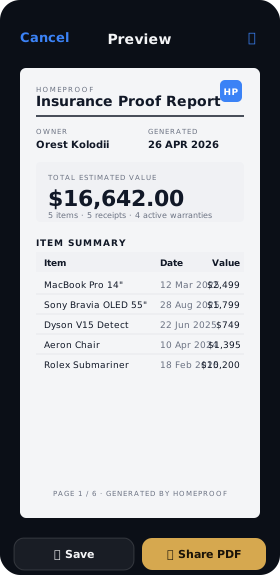
- Generate Insurance Report PDF with one tap. Owner block, total estimated value, item-by-item table, per-item proof page (photos + receipt + serial). Email directly to your adjuster.
- iCloud sync to your private CloudKit database. Even if your phone is stolen, the data lives in your iCloud.
- Free for first 20 items. $19.99/year for unlimited + insurance reports. The price equivalent of one month of a typical renters insurance premium — paid annually.
For more on what insurers specifically need at claim time, see our insurance claim checklist. For the broader renter playbook, see home inventory for renters.
Frequently asked questions
What documents do I need for a renters insurance claim?
Policy number, police report (for theft), photos of damage, itemized list with values, original receipts where available, and a written statement.
How long do I have to file a renters insurance claim?
Notification: 24-72 hours typically. Full filing: 30-60 days. Theft claims often need a police report within 24 hours.
Will my renters insurance pay without receipts?
Yes, but at lower amounts — typically 50-70% of replacement cost via actual cash value settlement.
Do I need a police report for every renters insurance claim?
Only for theft, burglary, vandalism. Not for accidental damage or water leaks.
How long does a renters insurance claim take?
7-14 days with complete documentation. 30-60+ days without. Major fire/water claims: 2-3 months.
Can I file a renters insurance claim entirely online?
Yes — most major insurers (State Farm, Lemonade, Allstate, Progressive) support full online filing.
Be ready before the next claim
HomeProof builds your insurance report PDF in 30 seconds — owner block, item table, proof pages. Free for first 20 items.
Download on theApp Store