Best home inventory apps compared (2026): Sortly, Encircle, HomeProof & more
"Home inventory app" is a category that hides three very different use cases. A small business tracking warehouse stock has nothing in common with a homeowner documenting the contents of a living room for insurance — yet they show up in the same search results. This guide breaks the field into the four leading apps in 2026 and matches each one to the use case it actually fits. Full disclosure: we make HomeProof. We've tried hard to be honest about where the others win.
How we evaluated
For each app, we tested or verified five dimensions:
- OCR accuracy & speed — scan a real thermal receipt, see what gets extracted
- Privacy posture — App Store disclosure + actual data flow (cloud vs on-device)
- Pricing & value — free tier limits, subscription cost, what's locked behind paywalls
- Insurance report PDF — does it generate one? How does it look?
- Platform availability — iOS, Android, web, multi-device sync
Pricing reflects publicly listed plans as of May 2026. Privacy disclosures are pulled from each app's current App Store page.
The comparison at a glance
| Feature | HomeProof | Sortly | Encircle | Itemtopia |
|---|---|---|---|---|
| Best for | Households & renters | Small business inventory | Property restoration pros | Casual home inventory |
| Free tier | 20 items | 100 items | None (free trial) | Limited |
| Paid plan starts | $19.99/year | $24/month/user | Quote-based | $3.99/month |
| OCR | On-device (Apple Vision) | Cloud-based | Cloud-based | No OCR |
| App Store privacy | Data Not Collected | Identifiers, Usage | Contact, Identifiers | Identifiers |
| Insurance Report PDF | Yes | Yes | Yes (advanced) | Basic export |
| Multi-device sync | iCloud (private) | Cloud account | Cloud account | Cloud account |
| iOS | ✓ | ✓ | ✓ | ✓ |
| Android | No | ✓ | ✓ | ✓ |
| Web app | No | ✓ | ✓ | No |
| Team / sharing | No | Yes | Yes | No |
Sortly: the small business choice
Sortly is the most popular general-purpose inventory app in the App Store. It's been around since 2014, has a polished interface, and supports barcode scanning, QR codes, and multi-user team access. The free tier is generous (100 items), which makes it a common starting point for households as well.
What Sortly does well
- Strong barcode & QR scanning — scan once, item details auto-fill from product databases
- Custom fields per item (great for tracking serial numbers, SKUs, or warranty info)
- Web app for desktop entry, plus iOS and Android
- Team features for sharing inventory with co-workers, family, or contractors
Where Sortly is a weaker fit
- Built around SKU-style inventory, not insurance proof. The interface feels business-y.
- Pricing scales fast: $24/month for Advanced, $74/month for Ultra, per user. Households get charged like teams.
- App Store privacy disclosure: Identifiers and Usage Data linked to user. Standard SaaS practice, but not "data not collected" territory.
- OCR runs cloud-side — your receipts are processed on Sortly servers
Best for: Small businesses, restoration contractors, organized hobbyists with 200+ items.
Less ideal for: Households of 5-50 items who just want proof for insurance and warranty claims without monthly fees.
Encircle: the insurance-claim specialist
Encircle is built for property restoration and insurance professionals. If you've had a fire or flood and a restoration company showed up, there's a good chance they used Encircle (or a similar tool) on their iPad to document the loss for the insurer.
What Encircle does well
- Industry-grade documentation — area-by-area floor plans, before/after photos, damage assessments
- Direct integration with major US insurers (claim filing pipelines)
- Built specifically for the claim-defense use case, with audit trails and chain-of-custody features
- Available on iOS, Android, and web with strong sync
Where Encircle is a weaker fit
- Pricing is quote-based and aimed at professionals — not consumer-friendly
- Steep learning curve. Forms and processes assume you're an adjuster or contractor.
- Overkill for a typical homeowner documenting their own contents
- Privacy disclosure includes Contact Info and Identifiers linked to user
Best for: Insurance adjusters, property restoration companies, public adjusters defending claims for clients.
Less ideal for: Individual households doing their own pre-claim inventory.
Itemtopia: the simple option
Itemtopia takes a different angle — a lightweight catalog app that's more about organizing things you own than building a paper trail for claims. Strong on collection management (think: comic books, sneakers, vintage toys); weaker on the receipt/warranty/insurance use case.
What Itemtopia does well
- Simple, fast item entry with photos and notes
- Category & tag system that's flexible for collections
- Cross-platform (iOS, Android) with cloud sync
- Affordable: $3.99/month basic plan
Where Itemtopia is a weaker fit
- No OCR — every receipt detail must be typed manually
- No insurance-grade PDF report generation
- No warranty reminders / expiry tracking
- Limited fields for the claim-relevant data (serial, model, purchase price, warranty term)
Best for: Collectors, hobbyists, anyone documenting things-they-own as a catalog.
Less ideal for: Anyone whose primary use case is insurance proof or warranty claims.
HomeProof: the privacy-first household vault
Disclosure: we make HomeProof. We're going to describe what we built, why we built it, and where it doesn't fit — honestly.
HomeProof is built for one specific user: a household (homeowner or renter) with 10-200 items worth documenting, who cares about privacy, doesn't want a monthly subscription, and uses iOS. Specifically:
What HomeProof does well
- On-device OCR. Receipts are scanned with Apple Vision on the iPhone. Text never leaves the device. The "Data Not Collected" App Store disclosure is real.
- Auto-extraction. Store name, date, total, currency, warranty term, and serial number get pulled into structured fields automatically.
- Warranty reminders. Set a notification 30 days before warranty expires. Don't miss claim windows.
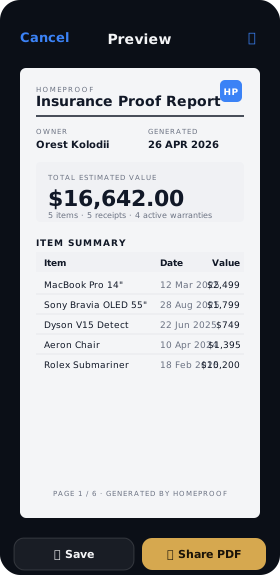
- Insurance Report PDF. One-tap. Owner block, total value, item table, per-item proof page (photos + receipt + serial). Email to insurer or save to Files.
- iCloud sync through your private CloudKit database. Optional. We don't have a server.
- Pricing. Free for 20 items. $19.99/year for unlimited + insurance reports + cloud backup. 7-day free trial.
Where HomeProof is a weaker fit
- iOS only. No Android. No web app. If your family is Android-mixed, this is a problem today.
- Single user. No team or sharing features. Designed for one household, one owner.
- No team-pricing tier. If you want to track shared business inventory with co-workers, use Sortly.
- No SKU / barcode database lookup. Barcode scanning works for serial entry but doesn't auto-fill product info from a global database.
Best for: iOS-only households and renters who want privacy + insurance-readiness without monthly fees.
Less ideal for: Mixed-platform families, business inventory, professional adjusters, large collections (1000+ items).
Decision framework: which one for which use case
| If you are… | Pick… | Why |
|---|---|---|
| Renter, 20-50 items, iOS | HomeProof | Cheapest, privacy-first, insurance PDF in 1 tap |
| Homeowner, 50-200 items, iOS | HomeProof | $20/year vs $300+/year, with same insurance output |
| Mixed iOS + Android household | Sortly | Only platform-agnostic option that's not enterprise pricing |
| Small business, 200+ items, team access | Sortly | Built for it; SKUs, custom fields, multi-user |
| Property restoration / insurance pro | Encircle | Industry-standard claim documentation |
| Collector documenting hobby items (no warranties) | Itemtopia | Lightweight, cheap, good for catalog |
| Spreadsheet works fine for me | Spreadsheet | Genuinely fine if <20 items and you're disciplined |
The privacy question
If you searched "best home inventory app" you probably haven't thought much about the privacy implications. They're worth knowing about.
Receipts contain:
- Credit card last-4-digits
- Storefront name, address, time of purchase
- Detailed line-item purchase patterns
- Total spending across categories over time
That data has resale value. When a home inventory app stores your receipts on its servers, that data — even if anonymized at rest — is a target for breaches, a candidate for ad-tech enrichment, and a liability if the company gets acquired.
Of the four apps in this comparison, only HomeProof's privacy disclosure says "Data Not Collected." The others are not malicious — they're following standard SaaS practice and need cloud-side data for the team features that distinguish them. But if your inventory is just for you, you don't need to make that trade.
The pricing math
For a typical household of 50 items used over 5 years:
| App | 5-year cost | Notes |
|---|---|---|
| HomeProof | $99.95 | $19.99 × 5 years; or $0 if you stay under 20 items |
| Sortly Free | $0 | Limited to 100 items, basic features |
| Sortly Advanced | $1,440 | $24/month × 60 months × 1 user |
| Encircle | Quote-based (typically $200+/month) | Aimed at professional users |
| Itemtopia | $239.40 | $3.99/month × 60 months |
For pure household use, HomeProof's flat $19.99/year is dramatically the cheapest option that includes OCR, warranty tracking, and insurance PDF generation. The pricing reflects scope: it's a single-user iOS app, not a multi-user cloud platform.
The right home inventory app is the one matched to your use case — not the one with the most features.
What about free spreadsheets?
Honest answer: a Google Sheet or Excel file is genuinely fine for under ~20 items if you're disciplined. The point at which it stops being fine:
- Item count crosses ~30 — adding a row takes longer than scanning
- You need to attach photos — spreadsheets handle them poorly
- You want the receipt OCR'd — spreadsheets can't do that
- You want a warranty reminder — spreadsheets can't do that either
- You want a one-tap PDF for an insurer — building one from a spreadsheet takes hours
The threshold where a dedicated app starts paying back its cost in saved time is roughly 30-50 items.
Frequently asked questions
What is the best home inventory app for iPhone in 2026?
Depends on use case. For privacy-conscious households of 10-200 items, HomeProof. For team-shared business inventory, Sortly. For insurance-claim professionals, Encircle. For lightweight collection cataloging, Itemtopia.
Do I need a home inventory app or is a spreadsheet enough?
Spreadsheet works under 20 items. Past 30 items, an app saves hours per year through OCR, photo attachments, and PDF generation.
Which home inventory app has the best privacy?
HomeProof — the only one with "Data Not Collected" in App Store disclosure and on-device OCR.
Is Sortly free?
Free for up to 100 items with basic features. Paid plans start at $24/month per user.
Can I use a home inventory app for insurance claims?
Yes — generated PDFs are exactly what claim adjusters request. Cuts settlement time from weeks to days.
Try HomeProof free
Free for your first 20 items. $19.99/year for unlimited + insurance PDFs.
Download on theApp Store