
How long should you keep receipts? Tax, warranty & insurance rules (2026)
The honest answer is "longer than you think, in less space than you fear." US tax law, manufacturer warranty terms, and insurance claim documentation each have their own retention rules — and they don't overlap. This guide breaks down exactly how long each receipt category should be kept, why the rules exist, and the cheapest way to keep them organized so you can actually find one when you need it.
The cheat sheet
If you only read one thing on this page, read this table. It's the answer to "how long to keep this receipt?" for the seven most common categories.
| Receipt type | How long to keep it | Why |
|---|---|---|
| Personal tax-related receipts | 3 years from filing | IRS audit window for typical returns |
| Tax-related (under-reported income) | 6 years from filing | Extended IRS audit window if >25% under-reporting |
| Bad debt / worthless securities | 7 years from filing | IRS deadline to claim those deductions |
| Property purchases (home, land, major improvements) | 3 years after sale | Cost basis for capital gains calculation |
| Standard manufacturer warranty | Warranty term + 90 days | Buffer for repair turnaround and disputes |
| Extended warranty (AppleCare+, Geek Squad, etc.) | Extended term + 90 days | Same buffer logic, longer horizon |
| High-value items (jewelry, watches, electronics for insurance) | For the lifetime of the item | Insurance claim proof has no expiration |
| Business expense receipts | 7 years | IRS guideline for business records |
Why the IRS rules look weird
The IRS retention rules trip people up because they aren't a single number. They're a stack of audit windows that depend on what kind of return you filed and what kind of error (if any) might surface later.
The 3-year rule (default)
For a typical taxpayer who files honestly and on time, the IRS has 3 years from your filing date to audit you. After that, the file is closed. This is the rule that applies to about 95% of receipts most households have.
The 6-year rule (under-reported income)
If you under-reported your gross income by more than 25%, the IRS gets 6 years to audit. This affects freelancers, side-business owners, and anyone with cash income who might have missed reporting some of it. Even if you're sure you didn't, the safer assumption is 6 years for any year you had untraditional income streams.
The 7-year rule (write-offs)
If you claimed a deduction for bad debt (e.g., a friend who never repaid a loan) or worthless securities, you have 7 years for the IRS to challenge it. Receipts that prove the loan was real, or that the security existed and lost value, fall in this bucket.
The "forever" rule (property)
Anything that affects the cost basis of property — the original purchase price of your home, major renovations, capital improvements — must be kept until 3 years after you sell the property. If that's 30 years from now, that's 30 years of paperwork. Digital scans solve this elegantly.
Warranty receipts: the 90-day buffer
Manufacturer warranties have a written term (1 year, 2 years, lifetime). What the warranty card doesn't say is that you need the receipt throughout that term plus a buffer for the actual claim cycle.
Here's why the 90-day buffer matters:
- Diagnosis time. The retailer or service center may take 2-4 weeks to diagnose the failure.
- Parts wait. If a replacement part isn't in stock, expect another 2-4 weeks.
- Receipt verification. The store may ask for the original receipt, again, after the diagnosis.
A 90-day buffer past the formal warranty end date covers all three. Without it, you might have a valid warranty claim but no receipt to prove the purchase date — and the warranty starts at the date of purchase, not the date you filed.
For more on managing warranties from purchase to claim, see our 2026 warranty playbook.
Insurance receipts: keep them indefinitely
Insurance is the category where receipt retention has no expiration. The reason: a contents claim can happen 1 year after purchase or 12 years after. If your laptop is stolen at year 12, you still need the original receipt to claim replacement value.
For the items insurers care about most:
| Category | Items | Retention |
|---|---|---|
| Electronics | Laptops, TVs, cameras, gaming consoles, phones | Lifetime of ownership |
| Appliances | Washers, dryers, dishwashers, refrigerators, ovens | Lifetime of ownership |
| Jewelry & watches | Anything with an appraisal or over $500 | Lifetime + appraisal updates every 5 years |
| Bikes & sports equipment | Bikes, e-bikes, golf clubs, snowboards, surfboards | Lifetime of ownership |
| Furniture | Sofas, beds, dining sets, antique pieces | Lifetime of ownership |
| Musical instruments | Guitars, pianos, brass and woodwinds | Lifetime + appraisal for vintage pieces |
If you've ever filed a contents claim, you know the question that decides the payout amount: "Do you have the receipt?" For more on what insurers actually need at claim time, see our insurance claim checklist.
Paper vs digital: the case for scanning
The single biggest mistake people make with receipts is keeping them on paper. Three reasons:
1. Thermal paper fades
Most retail receipts in 2026 are still printed on thermal paper. The chemistry is heat-sensitive — which is why the receipt darkens when you press a coin to it for a few seconds. The same chemistry means within 12-18 months at room temperature, the print fades to unreadable. Receipts stored in wallets near body heat fade faster. Receipts in a hot car fade in weeks.
2. Search is impossible
Even if you've kept every paper receipt for a decade in a shoebox, finding the one you need takes 30 minutes of digging. Tax season requires you to surface 40 of them. Insurance claims require you to find the right 8.
3. Loss is inevitable
Moves. Floods. Fires. Toddlers. Spouses cleaning out the kitchen drawer. Paper receipts are one accident away from being gone. The very event that triggers an insurance claim — fire, flood, theft — often takes the receipts with it.
Digital receipts solve all three. The IRS, every major insurer, and most warranty programs accept clear digital scans of receipts as proof. Scan once, find later.
How to digitize receipts (the right way)
Not all digital receipts are equal. Here's the priority order from "best" to "barely acceptable":
- Email PDF directly from retailer. Best. Most online stores email a receipt automatically. Save it.
- Screenshot of email confirmation. Acceptable for most claims, but requires the email to still be in your inbox.
- Photo + OCR scan. The standard for paper receipts. Use a dedicated scanner app that runs OCR locally on your phone (so the data doesn't leak to a server).
- Photo without OCR. Last resort. Forces you to find the receipt visually instead of by search.
For paper receipts, the best workflow is a phone-based receipt scanner that:
- Captures the receipt image with edge detection (auto-crop)
- Runs OCR on-device (Apple Vision on iOS 17+ or ML Kit on Android)
- Extracts store name, date, total, and currency
- Stores the file in a place you control (iCloud Drive, Google Drive, or app-internal with export)
The on-device OCR detail matters: cloud OCR services send your purchase history to a third-party server. For the rare receipt you really care about (a $4,000 laptop, a $1,200 watch), that's a privacy trade you don't need to make in 2026.
The 30-minute receipt sweep
Block 30 minutes one Saturday. Then:
- Empty the kitchen drawer. Pile every paper receipt on the kitchen counter.
- Sort by category (in 4 piles): Electronics & appliances, Jewelry & watches, Furniture, Everything else.
- Scan the keepers. Anything from category 1-3 — scan it. Anything in category 4 — toss unless it's recent and tax-relevant.
- Email search the rest. Search Gmail/Outlook for "receipt" + the year. Save PDFs of each.
- Tag and store. Each scan should be tagged with the item name, category, and date. Store in one searchable place.
That's it. Once. From there, scan as you go — every new purchase over ~$100 takes 30 seconds at the moment of unboxing.
How HomeProof handles this
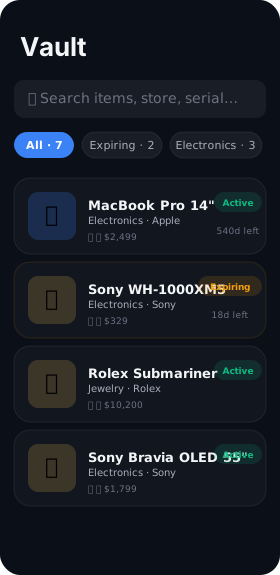
HomeProof was built specifically for the household-receipts retention problem. Here's how it maps to the rules above:
- On-device OCR. Receipts are scanned with Apple Vision on your iPhone. The text never leaves the device.
- Auto-extraction. Store name, date, total, currency, and warranty term (when written on the receipt) are pulled into structured fields automatically.
- Warranty reminders. Set a reminder for 30 days before the warranty expires. The 90-day buffer is automatic — the reminder fires regardless of how busy you are.
- Insurance Report PDF. Generate a one-tap PDF with your owner block, total value, item table, and per-item proof pages. Email to insurer or store in iCloud Drive.
- iCloud sync. Optional. Data syncs to your private CloudKit database. We don't have a server. Even if HomeProof shut down tomorrow, your data is on your devices.
- "Data Not Collected" in the App Store privacy disclosure. No analytics, no tracking, no ads. The Sentry SDK we use for crash reports is configured to never include user data.
Free for up to 20 items, $19.99/year for unlimited items + insurance reports + cloud backup. There's a 7-day free trial if you want to test the workflow before committing.
The cheapest insurance is paperwork you can find when the moment matters.
Frequently asked questions
How long does the IRS require you to keep receipts?
3 years from your filing date for a standard return. 6 years if you under-reported income by more than 25%. 7 years if you claimed a write-off for bad debt or worthless securities. Forever (until 3 years after sale) for property cost-basis records.
Should I keep paper or digital receipts?
Digital. Thermal paper fades within 12-18 months, paper receipts get lost, and search is impossible. The IRS and every major insurer accept clear digital scans as proof. Scan once, find later.
How long should I keep receipts for warranties?
The warranty term plus 90 days as a buffer for repair turnaround. For extended warranties, the extended term plus 90 days. For lifetime warranties, keep forever.
Do I need receipts for insurance claims?
Strongly recommended. Without one, insurers settle on actual cash value (depreciated) rather than replacement cost. For high-value items, keep receipts indefinitely.
Is a credit card statement enough proof?
For tax: no. The IRS requires the actual receipt showing what was purchased. For insurance and warranty: acceptable as fallback, but original receipts always settle faster.
What about business expense receipts?
7 years per IRS guidelines. Each receipt should include date, amount, vendor, and business purpose.
Make receipt retention painless
HomeProof is free for your first 20 items — and free forever for the workflow.
Download on theApp Store